

How To: Start with calisthenics
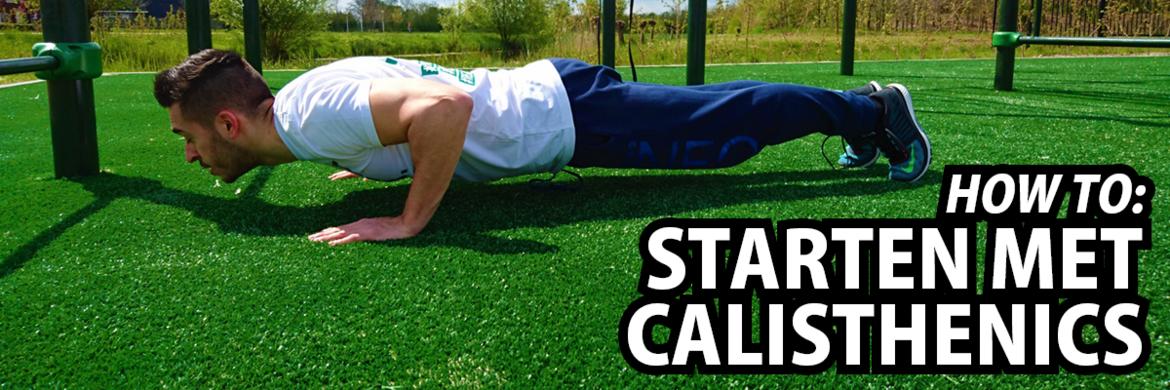
Are you just starting calisthenics or thinking about it? Are you looking for a good beginner's workout? We've added this article to our calisthenics blog especially for you. In this article, we'll explain, among other things, which exercises to start with, how to master them, and what else you should consider. The goal of "How To: Start Calisthenics" is to lay a solid foundation by mastering the basic calisthenics exercises. Only once you've mastered these can you move on to more advanced calisthenics exercises, such as muscle-ups and handstand push-ups.
Before you start calisthenics
When you're just starting calisthenics, it's important to build up slowly and not overdo it. Your muscles, tendons, and the rest of your body need to get used to the new demands. It's also important to start every workout with a proper warm-up. During the warm-up, it's important to warm up your muscles and tendons and get your blood flowing. So don't skip this. A good warm-up will positively impact your strength and endurance for the rest of your workout. A jump rope can be very helpful in this regard. We recommend the Speed Rope Survival . Thanks to its steel ball bearing system, the jump rope spins more smoothly and quickly than a regular jump rope. It's no wonder martial artists use it during their strength and conditioning training.
The five basic exercises of calisthenics
Always remember that it's important to train the entire body, including your legs! This workout focuses on every part of the body: back, chest, shoulders, arms, core, and legs. The calisthenics beginner workout consists of the five basic calisthenics exercises: push-ups, pull-ups, dips, pistol squats, and L-sits. Make sure you've mastered each step before moving on to the next.
1. The push-up
We'll start with push-ups. It's perhaps the most well-known of the five basic exercises we'll cover in this article. Push-ups primarily require strength from the chest, shoulders, and triceps.
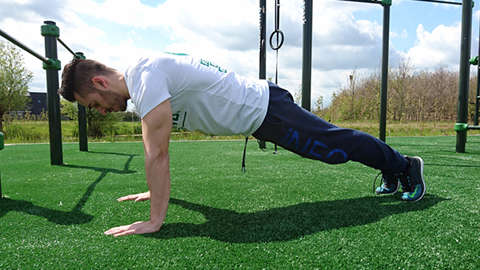
Step 1: Knee push-ups
The first step to mastering push-ups is performing knee push-ups. Kneel down and place both hands shoulder-width apart on the floor. This is the starting position. Now slowly lower yourself down until your chest almost touches the floor. Then push yourself back up to the starting position. Make sure your body remains still throughout the exercise and only move your arms. To relieve stress on your wrists, you can use these push-up supports .
Step 2: Incline push-ups
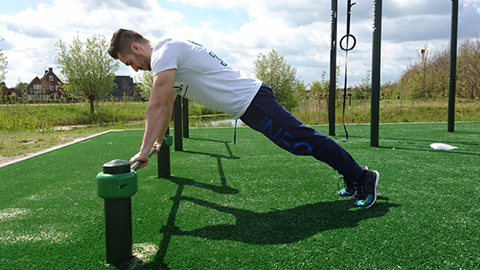
If knee push-ups are easy for you, you can move on to incline push-ups. Find an object that's higher than the ground, such as a wall, step, or bench. In the example photo below, we're using a bar. Stand upright and place your hands on the chosen object. Keep your body in a straight line and slowly lower yourself. Then push yourself back up. Start with a relatively high object and gradually work your way down to a lower object, until you don't need one at all.
2. The pull-up
2. The pull-up
The pull-up, also known as a pull-up, is an excellent exercise for targeting the back muscles and biceps. It requires a lot of strength, so it can take a while to master. So don't give up immediately and follow these steps as best as you can. That's the only way to succeed!
Step 1: Australian pull-ups
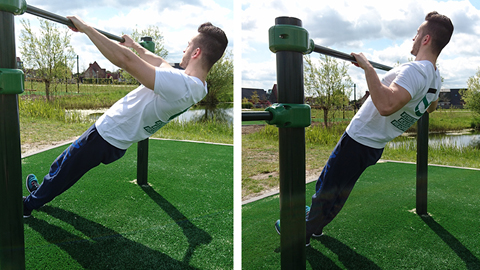
We'll start with Australian pull-ups. This pull-up variation is an excellent way to work towards pull-ups. Stand with your back facing the floor, hanging under a horizontal bar, as shown in the photo below. Grip the bar slightly wider than shoulder-width. This is the starting position. Pull your chest towards the bar. Then slowly lower back to the starting position. The lower the bar you use, the more difficult the exercise becomes. Tighten your abs and keep your body in a straight line.
Step 2: Australian pull-ups small/wide grip
We'll stick with the Australian pull-ups for a moment, but now switch grip positions. Assume the same position as in the first step, but hold the bar very wide or very narrow.
Step 3: Resistance band pull-ups
In this step we will use resistance bands. The Pull-Up Pack, to be precise. This is a specially designed package that helps you perform the perfect pull-up step by step. The package consists of three resistance bands, each with a different resistance. Attach the band to a high bar. Then step onto the band with both feet and grab the bar with your hands. Pull yourself up slowly and under control. Hold this position for one second and then slowly lower yourself back down. Start with the strongest band in the package and work your way down to the lightest band. When you can perform a number of repetitions with the lightest band, it's time to perform the pull-up unassisted.
3. The dip
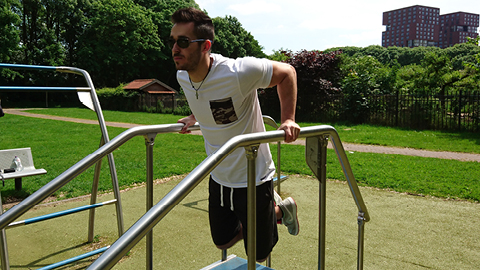
The third basic calisthenics exercise is the dip. Dips are typically performed on two parallel bars, but you can also use something like two chairs. Just make sure they're sturdy and stable. Dips are an excellent exercise for your triceps and pecs.
Step 1: Behind the back dips
First, find a chair, step, or bench on which you can perform the behind-the-back dip. With both hands behind your back, place your palms on the object, as shown in the photo below. Now slowly lower yourself down until your elbows are at a ninety-degree angle. Use only your arms and keep the rest of your body still. Now push yourself back up to return to the starting position.
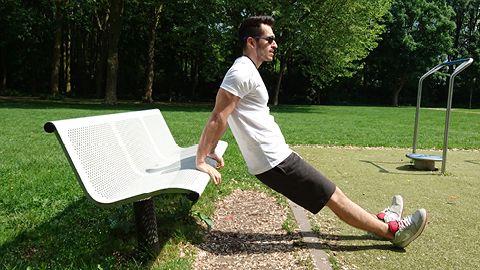
Step 2: Behind the back dips with elevated legs
This exercise is a challenging variation on the first step. You'll perform the behind-the-back dips again, but this time you'll place your legs on a raised platform.
Step 3: Negative dips
Time for the real work! Stand between two parallel bars. You can use the Adjustable Equalizer for this. Place your hands on the bars. Jump up so that both feet leave the ground and your entire body weight is supported by your arms. This is the starting position. Now lower yourself down as slowly as possible until your elbows are at a ninety-degree angle and your feet are touching the ground. Then jump back up to return to the starting position. At first, you'll probably sink quickly and uncontrollably. As you practice the exercise more often, this will become easier. Finally, try to push off the ground less forcefully as you approach the starting position. This will allow you to use more power from your arms instead of your legs.
4. The pistol squat
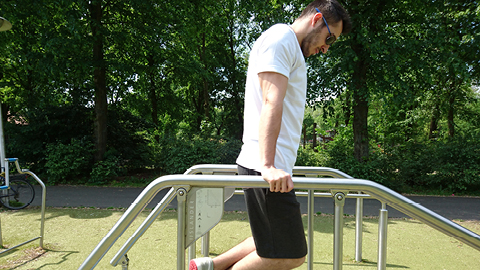
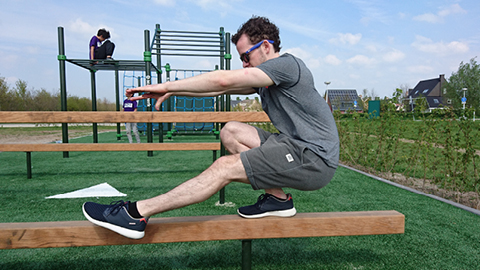
We've arrived at the legs. Many consider this the least enjoyable part of the body to train. Yet, it's crucial not to skip it. Training your legs releases more growth hormone and testosterone into the body. This stimulates muscle growth throughout the body. The pistol squat is a single-leg squat with the other leg pointed straight out, giving the body the appearance of a pistol. Hence the name pistol squat.
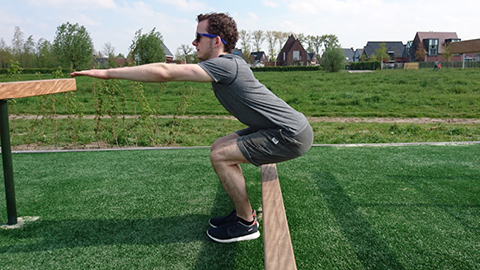
Step 1: Bench Squats
Let's start easy. Find a box, chair, or just a park bench. Stand in front of the object, facing it. Place your feet shoulder-width apart. This is the starting position. Now slowly bend your knees until you're sitting on the bench. Then stand back up, returning to the starting position. Make sure your knees don't extend too far past your toes and try to push through your heels as you squat. Gradually find a lower object until you can squat low enough for your knees to form a ninety-degree angle.
Step 2: Explosive squats
Now we'll pull the object out from behind us. Squat down as deeply as you can. Then jump up as explosively as possible, lifting your feet off the ground. As you get better at this, try to pull your knees in as you jump up.
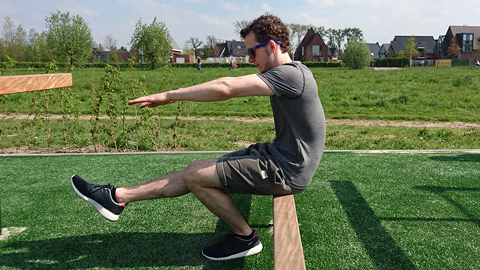
Step 3: Bench pistol squats
For this step, we'll again use a bench, box, or chair. Stand on one leg and extend the other leg out in front of you. This is the starting position. Now slowly squat down until you're sitting on the object. Return to the starting position. To maintain your balance, you can extend your arms forward during this exercise.
Step 4: Assisted pistol squats
Now remove the object from behind you. Perform the pistol squat while supporting yourself with one arm on a pole or resistance band. Gradually try to rely less on your arm and more on your leg. Continue until you can do it without additional support.
5. The L-sit
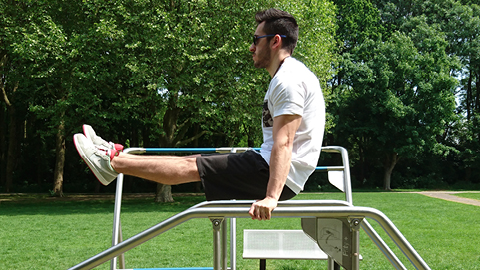
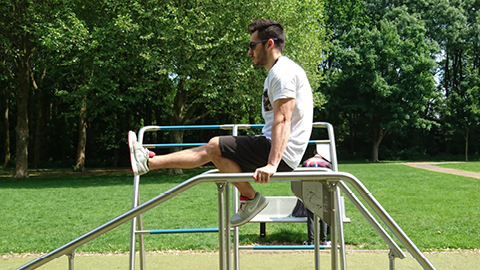
The L-sit is a static position that you hold for a few seconds. Just like the dips, you perform the L-sit on two parallel bars. You can also use the Adjustable Equalizer for use. The L-sit requires abdominal strength, but your shoulders and arms must also be strong enough to support your body weight. The name L-sit comes from the position you adopt, which resembles the letter "L" from the side.
Step 1: Knee raises
Stand between two parallel bars. Grab them with both hands and jump up. Your legs should hang straight down, and your arms should rest on the bars. This is the starting position. Bend your knees and slowly and controlledly raise your legs until they are parallel to the ground. Now lower your legs back to the starting position.
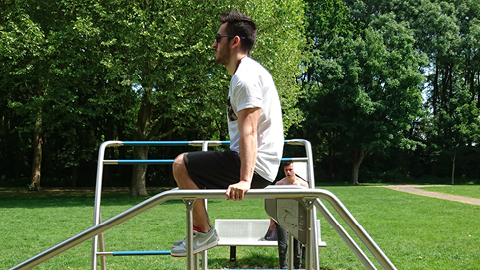
Step 2: Tucked L-sit hold
Repeat the first step, but try to hold your legs at the top for a few seconds.
Step 3: Leg raises
Repeat the first step, but instead of bending your knees, keep your legs fully extended.
Step 4: Single leg L-sit
You're just one step away from a full L-sit. Assume the starting position, but with your legs out in front of you and your knees bent at ninety degrees. Fully extend your left leg while keeping the other bent. Try to hold this position for as long as possible. When you can no longer do this, switch legs. One set Steel Parallettes can be very useful for this exercise.
The first step is done. You've read the "How To: Start Calisthenics" guide. Hopefully, you've learned a lot and know what to do next. Time to get started! Go outside (or inside) and get going. Want to know how to incorporate these exercises into a workout? Then read the article: Calisthenics beginner's schedule . We offer two types of beginner workout schedules, showing you exactly how many sets, reps, and exercises you should perform. Persevere and don't give up until you reach your goal. #ReachYourGoal


